

Be Here Now: The Enduring Influence of Oasis
Echoes of the Manchester band's sound can be heard far beyond the lad rock of Kasabian and White Lies. David Coleman explores their complicated legacy.
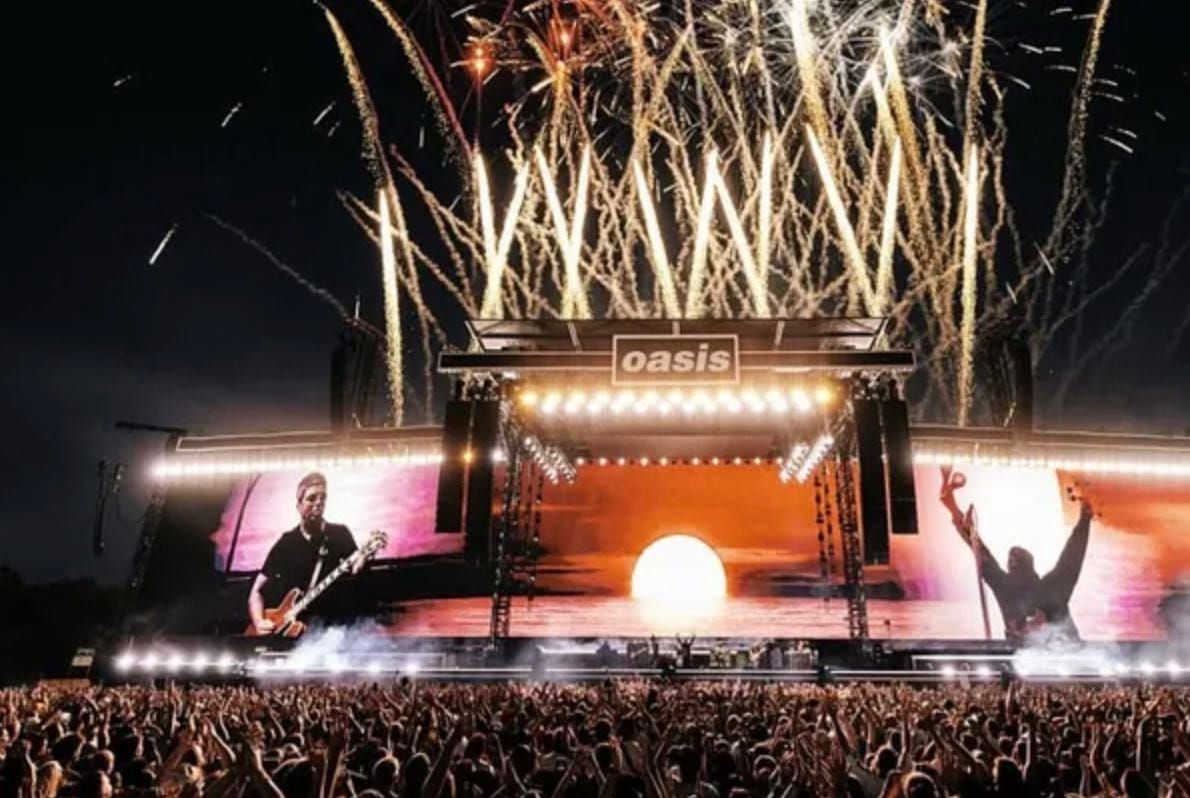
The successful return of Oasis has inevitably stirred up some feelings, nostalgia being the most obvious.
As a 90s kid from the north of England, it’s no surprise that the first two Oasis albums and The Masterplan played an important role in my musical development. I burned through those records. Be Here Now, the band’s difficult third album, was one of the first releases I remember being truly excited about.
“D’You Know What I Mean?” came out in the summer of 1997, and expectations were at fever pitch. I was at an army cadet camp—don’t judge me, it was mandatory. Yes, I went to a weird school—at the time and that song was everywhere. It was undoubtedly in my head when I managed to lose a magazine of blank rounds on a training exercise. I didn’t think it was a big deal, but it caused absolute chaos — scenes of hundreds of people combing the open countryside in search of my missing ammunition are inextricably linked to the “D’You What I Mean Video” in my head.
We all know what happened next. Everyone loved Be Here Now, until they decided they didn’t — and the age of Oasis was over. Or so it seemed.
Last summer, when Liam and Noel announced their live return, the feeling was one of scepticism. Having already seen the hollow shell of Oasis at Reading Festival in 2000, I decided to give it a miss.
Nearly twelve months on, I’m starting to experience pangs of jealousy and even a faint hint of regret, as friends post breathless tributes to “the best gig ever” and send me video clips that don’t seem entirely awful. Recent setlists, which focus almost entirely on the band’s 90s oeuvre, undoubtedly help make the reunion shows a more enticing proposition.
More than anything, the band’s startling return to prominence has prompted a re-evaluation of their place in my heart. I had sidelined Oasis, writing them off as a teenage gateway to better things — an embarrassing phase. Oasis themselves played a part in this. The band’s idiotic antics and diminishing returns musically tainted the Oasis brand, while overexposure dulled the potency of their biggest hits. I will never need to hear “Don’t Look Back In Anger” or “Wonderwall” ever again.
The band’s immediate impact on British guitar music also contributed to my perception of their legacy. A horde of increasingly obnoxious Liam-alikes filled the post-Gallagher void (think Kasabian, White Lies, The Enemy), polluting the airwaves with their turgid third-hand takes on laddish pub-rock.
If you are prepared to push all of this to one side — forget the tabloid stories, discount their lacklustre 2000s output, and forgive them for fuelling the rise of Kasabian — the influence of Oasis starts to look a little different. It’s a big “if” though, as the following snippet from The Guardian last year highlights:
Lyrically, too, they’re dismal: the promisingly mischievous Elsa/Alka-Seltzer rhyme of debut single Supersonic soon gave way to dull platitudes that might as well have been written by AI. But the problem is the music. Oasis don’t do fast songs. Noel plays his guitar as if he’s scared it will break, and Oasis’s funkless, sexless plod is always carefully pitched below the velocity at which fluid dynamics dictate that you might spill your lager. Is there anything more useless than a rock band that doesn’t rock?
Simon Price, for The Guardian (2024) — he also called Oasis “the most damaging pop-cultural force in recent British history”
I can kind of see Price’s point, but it requires a certain contortion to make this argument. Many of Noel Gallagher’s lyrics are ridiculous, but they also work. “Maybe I don't really wanna know / How your garden grows / 'Cause I just wanna fly” — on the page it looks ridiculous, but enveloped in the magic of “Live Forever” it sounds transcendent. That’s a skill. How can ordinary lyrics, predictable chord progressions, and a plodding rhythm combine to such effect? And it isn’t just a one-off — Definitely Maybe is loaded with songs that far exceed the sum of their unremarkable parts.
My recent reflections on Oasis have led me to a hypothesis of sorts. While British bands tend to copy the tabloid caricature of Oasis — the attitude, the swagger, the Liam axis — overseas admirers, benefitting from the absence of The Sun and The Daily Mail in their lives, take cues from the music, the anthemic nature of the songs, the Noel axis. My evidence is gathered below in playlist form. It’s not scientific, but if you prefer simpler terms: Oasis influenced a lot of artists, many of whom are not outwardly “mad fer it”.
I’m not going to write at length about these picks, but I do want to offer a brief introduction and highlight a few picks. Firstly, not everything here sounds like Oasis. A few tracks do, but I wanted to highlight more surprising influences and compile a playlist I enjoy. It’s worth noting that every song presented is from the last five years, too.
The guitar solo in Alvvays’ “Belinda Says” and the whole Chime School track scream pure Noel to me. Stannington are an up-and-coming band from Newcastle — vocally, I’m reminded more of Morrissey, but those thudding guitars sound like early Oasis to me. If Alan Moulder had produced Definitely Maybe it would probably sound like Manchester’s Pastel. Elsewhere, American artists Enumclaw, Dazy, and Snail Mail have all talked about their affection for Oasis, while Norway’s Beachheads and New Zealand’s Best Bets suggest an even greater international reach.
A Spotify playlist is embedded below. If you don’t like Spotify, feel free to convert this so you can listen via the provider of your choice.
I’d really love to hear your thoughts on this playlist, on other bands you feel Oasis have inspired, and on the band in general. Did you go to a reunion show? Tell me about it — especially if you hated every minute.


Comments ()